

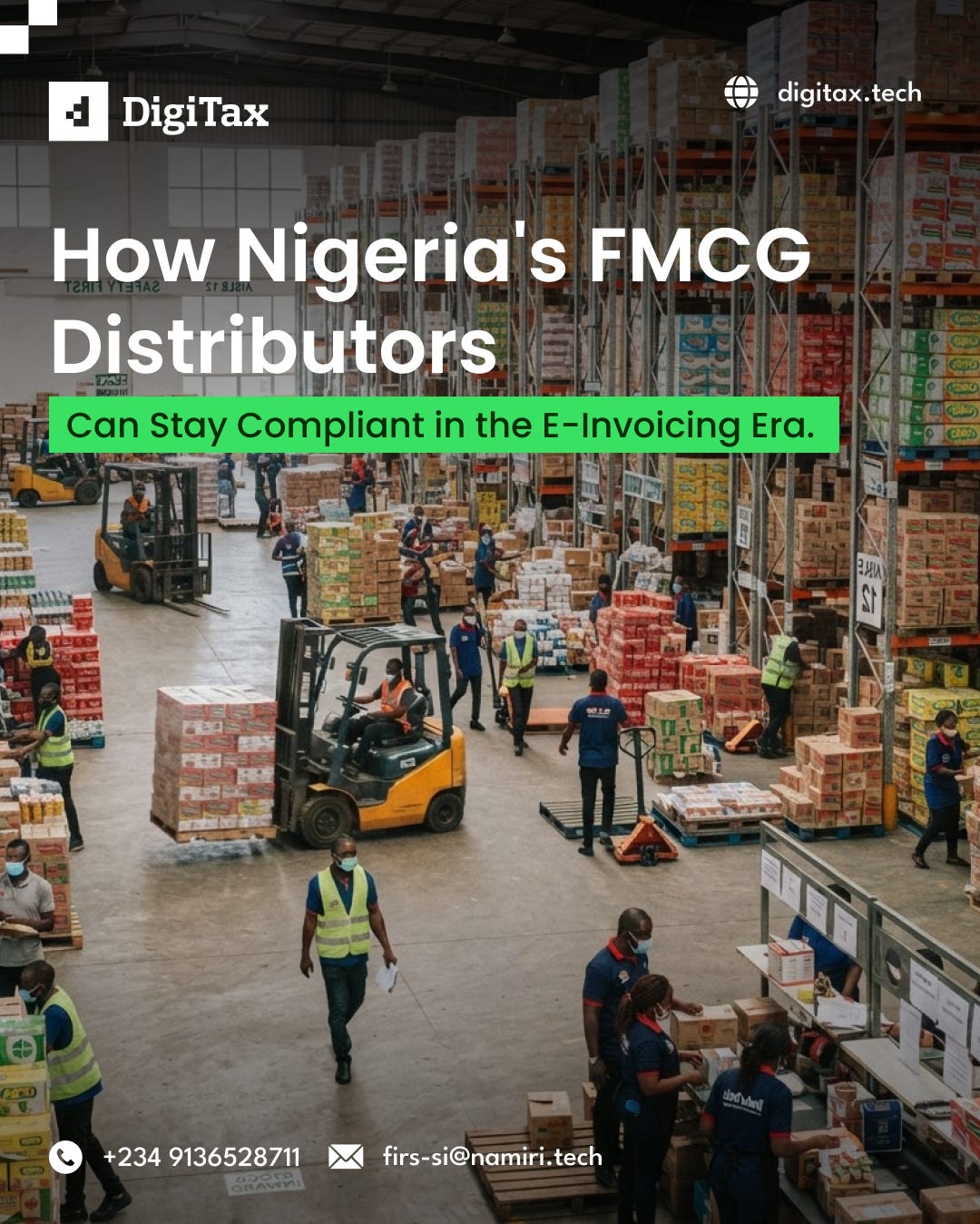
Somewhere between a Lagos manufacturing plant and a kiosk in Kano, a truck is being loaded before dawn. On it: cartons of the same handful of fast-moving goods, soap, seasoning, soft drinks, biscuits, cement and others,bound for a network of distributors, sub-distributors, and retail outlets that stretches across states most head offices never see directly. This is how FMCG actually moves in Nigeria: not from manufacturer to shelf, but through two or three layers of distribution in between.
It’s also exactly the layer where Nigeria’s NRS e-invoicing mandate creates the most operational friction, because distributors sit at the intersection of two very different compliance realities: manufacturers who are large, systems-capable, and already integrated with NRS, and downstream retailers who are frequently small, informal, and unaware the mandate applies to them at all.
The NRS Mandate, in Brief
Nigeria’s NRS Merchant Buyer Solution requires businesses to issue e-invoices that are validated and reported to NRS in real time, structured in a standard format, for both VAT and income tax purposes. The rollout began with large taxpayers running ERP systems capable of API integration, with the obligation extending progressively down the business scale. For a distributor, that means the compliance clock is already running on the buying side, invoices received from manufacturers, even in markets where the selling side, invoicing retail customers, is still catching up.
Where Distributors Carry the Exposure
Upstream: invoices from manufacturers. Most FMCG manufacturers supplying Nigerian distributors are large enough to already be NRS-compliant, so a distributor’s exposure here is mostly about receiving and correctly matching those invoices, not generating them. The risk is more mundane than dramatic: mismatched line items, incorrect buyer details, or invoices that don’t reconcile cleanly against purchase orders, all of which can hold up a distributor’s own input VAT claim on that purchase.
Downstream: invoices to retail customers. This is where it gets structurally harder. A distributor selling to hundreds or thousands of retail outlets, supermarkets, provision stores, open-market traders, is issuing the invoice itself, and the mandate requires that invoice to be NRS-compliant regardless of how small or informal the buyer is. High transaction volume across a fragmented retail base makes manual compliance checking impractical without a system doing the validation automatically.
In between: the sub-distributor layer. Many FMCG supply chains run through sub-distributors who are themselves informal or under-resourced. A distributor selling through this layer inherits the same documentation risk that flows through any fragmented supply chain, the invoice a sub-distributor issues onward may or may not meet the standard, and that gap can surface in the distributor’s own reconciliation long after the sale happened.
Three Structural Challenges Specific to FMCG Distribution
Volume, not value, drives the risk. FMCG distribution runs on thin margins and high transaction counts, dozens or hundreds of invoices a day per outlet network. The compliance burden scales with transaction volume far more than with contract value, which is the opposite of how most finance teams are used to prioritising risk.
Multi-tier supply chains blur accountability. With manufacturer, distributor, and sub-distributor all touching the same goods before they reach a retail shelf, it’s easy for compliance gaps to open at a tier nobody is actively monitoring.
Retail-facing invoicing has to work at the point of sale. Distributors selling directly into retail outlets need invoicing that happens where the transaction happens, often via a mobile POS device in the field, not back at a head office days later.
Getting Ahead of It
The practical fix isn’t a manual invoicing process bolted onto existing sales workflows, it’s integration at the point where the transaction is already being recorded. For distributors running ERP or sales-force-automation tools, connecting that system directly to a NRS-accredited integrator means every sale, upstream or downstream, generates a compliant invoice as part of the transaction itself, rather than as a separate step someone has to remember to do later.
For the manufacturer-facing side, that same integration reconciles incoming invoices against purchase orders automatically, flagging mismatches before they become a blocked input VAT claim rather than after.
Nigerian FMCG distributors sit between NRS-compliant manufacturers upstream and a fragmented, often informal retail base downstream, with real compliance exposure on both sides.
The upstream risk is mostly reconciliation accuracy; the downstream risk is generating compliant invoices at high volume across many small buyers.
Sub-distributor layers can create compliance gaps that surface later, in the distributor’s own books, long after the transaction closed.
Point-of-sale integration — not manual, after-the-fact invoicing, is what makes compliance viable at FMCG transaction volumes.
Ready to Simplify NRS Compliance Across Your Distribution Network?
DigiTax is an accredited NRS e-invoicing integrator, connecting directly with the ERP and POS systems distributors already use, so every transaction, upstream or downstream, is compliant as it happens.
Book a Demo Now https://tally.so/r/mV5LkJ or firs-si@namiri.tech | +2349136528711