

Introduction
On 31 August 2026, the Kenya Revenue Authority (KRA) issued a public notice announcing the integration of the Electronic Tax Invoice Management System (eTIMS) with the Integrated Financial Management Information System (IFMIS). This is a significant development for any business that supplies goods or services to government entities.
What is IFMIS?
IFMIS is the financial management system used by the national and county governments to process budgets and payments. When a government entity procures goods or services, the payment to the supplier is ultimately processed through IFMIS.
What the integration means
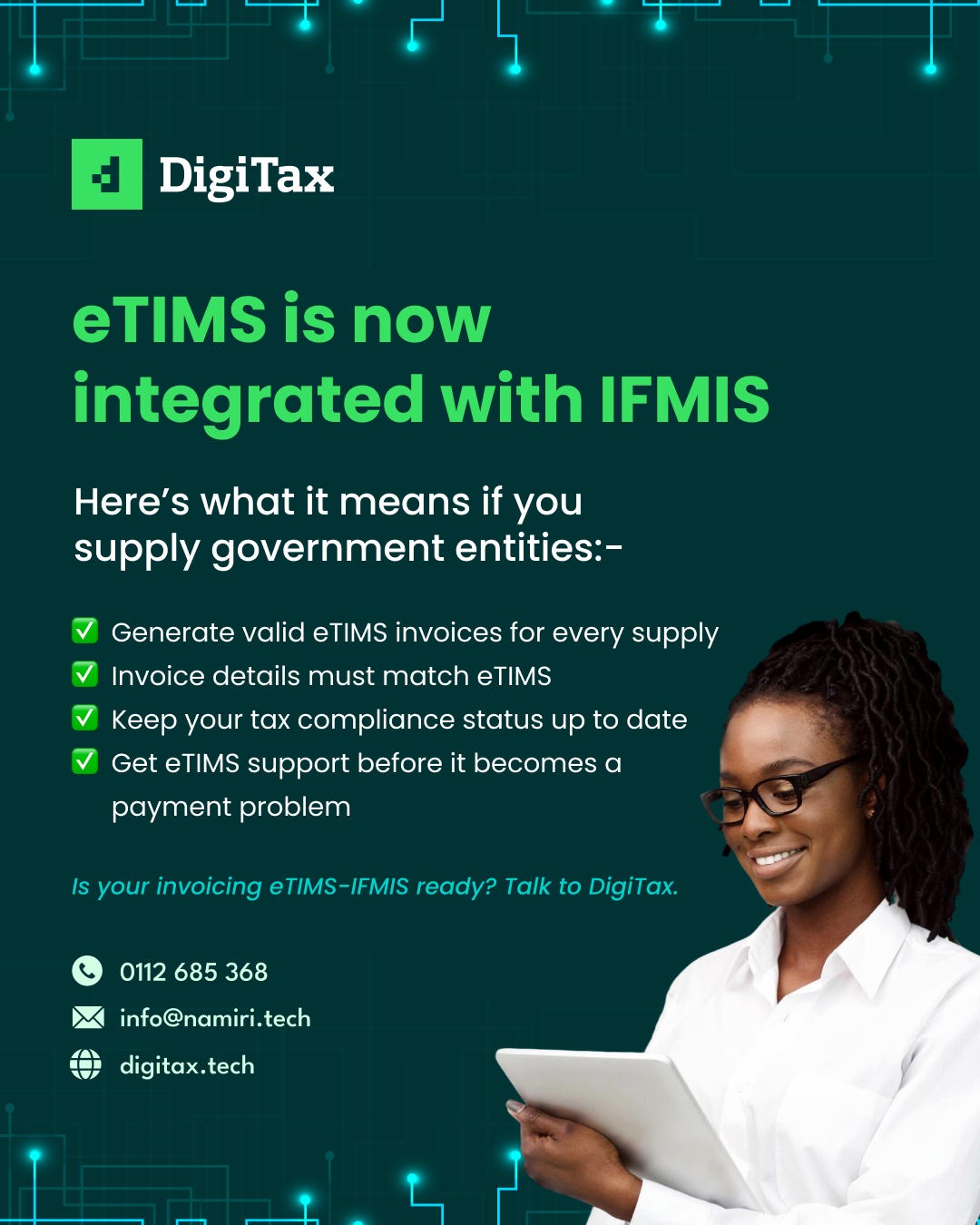
KRA and the National Treasury have linked eTIMS directly to IFMIS. The effect of this integration is highlighted in the public notice as:
government suppliers can only be paid if they have eTIMS compliant invoices;
the details of the invoices submitted to government entities must correspond precisely with the invoices generated and recorded in eTIMS.
suppliers will be required to regularly verify their tax compliance status and ensure that their tax records and information are accurate and up to date.
suppliers are encouraged to regularly verify their tax compliance status and ensure that their tax records and information are accurate and up to date
What is not clear from the public notice is eTIMS compliance by government entities. Various government entities provide services to taxpayers which are tax deductible business expenses (e.g. licenses, government fees, permits) but they do not provide eTIMS compliant invoices. This leads to these expenses not being deductible for tax since they are not eTIMS compliant.
Conclusion
The eTIMS-IFMIS integration is a welcome move and will ensure that suppliers remain eTIMS compliant. Suppliers who are not eTIMS-compliant, or whose invoicing processes produce inconsistencies, will find themselves unable to receive payment. Lastly, we hope to see that the same eTIMS compliance requirements are placed on government entities so that taxpayers dealing with government are not disadvantaged.
For further guidance on eTIMS compliance and integration with IFMIS, please contact Digitax.