

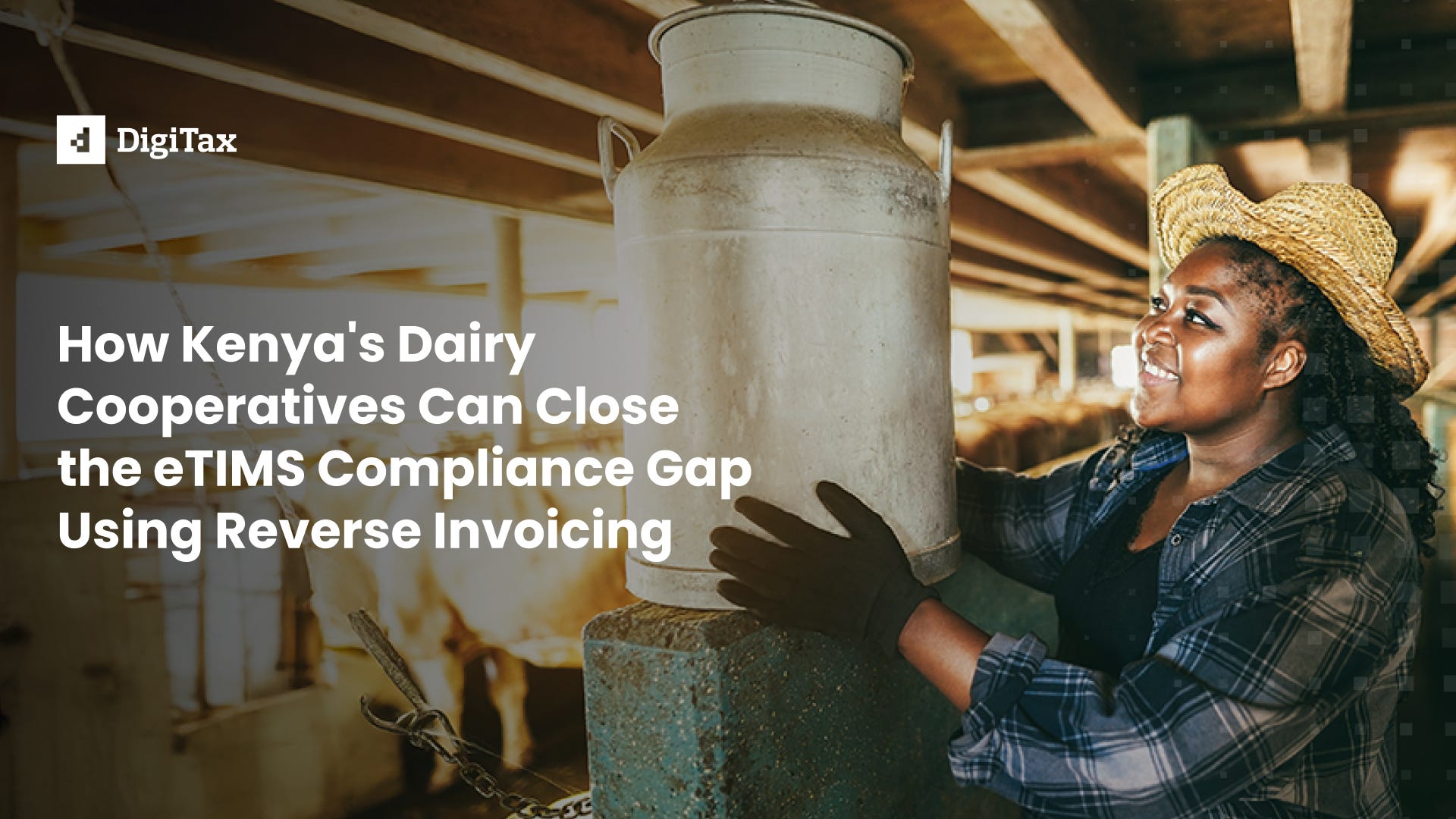
Every morning, across Kenya’s dairy belt, the same transaction repeats itself hundreds of thousands of times. A smallholder farmer carries a can of milk to a collection point. It’s weighed, tested, recorded. A cooperative or processor takes ownership of it. Money will change hands eventually, usually weeks later, as part of a bundled payment.
What doesn’t happen, in almost every one of those transactions, is an eTIMS-compliant invoice.
That gap sits at the centre of one of Kenya’s largest and most economically important sectors. Dairy contributes an estimated 4% of GDP and supports the livelihoods of over 1.8 million smallholder farmers. It is also, structurally, one of the hardest sectors in the country to bring into full e-invoicing compliance — not because the businesses involved are unwilling, but because the shape of the supply chain works against it.
This installment of our sector-by-sector series looks at why that is, and how reverse invoicing — introduced under the Tax Laws (Amendment) Act, 2024 — offers dairy cooperatives and processors a practical way through it.
The Value Chain: Dairy Sector
The dairy sector isn’t a single supply line. It’s a chain of independent participants, each with their own documentation obligations: smallholder farmers, cooperatives, milk collection centres, transporters, processors, distributors and retailers.
Every one of these participants is required to issue eTIMS-compliant invoices for taxable supplies, and to hold eTIMS-compliant documentation to support deductible expenses. In a sector this fragmented, that requirement touches an enormous number of individual transactions — and the vast majority of them originate with smallholder farmers who have neither the infrastructure nor, in many cases, the awareness to issue a compliant invoice for a milk delivery.
Beyond the raw milk itself, dairy cooperatives and processors carry significant expenditure on transport and refrigerated logistics, veterinary services, animal feed, equipment maintenance and packaging — much of it sourced from small, informal operators who are equally unlikely to be eTIMS-compliant.
Four structural features of the dairy sector make this a harder compliance problem than most:
Volume and frequency. Milk collection happens daily, not periodically. A single cooperative can record hundreds of individual farmer deliveries before breakfast, each one a separate purchase transaction requiring its own documentation. Manual compliance simply doesn’t scale to that volume.
Smallholder capacity. Most dairy farmers operate below the VAT registration threshold, have limited digital literacy, and little practical understanding of eTIMS obligations. Expecting each one to independently generate a compliant invoice for every delivery isn’t a realistic compliance strategy.
Informal service providers. Transporters, casual labourers at collection centres, small feed suppliers and local equipment mechanics are woven into daily dairy operations — and most of them are unable to issue eTIMS-compliant invoices, leaving the paying business without documentation to support the expense.
Bundled payment cycles. Farmers are typically paid fortnightly or monthly against accumulated deliveries, net of advances, input credit and cooperative levies. That settlement structure makes it genuinely difficult to match an individual payment back to an individual, compliant invoice.
Any one of these on its own would be manageable. Together, they describe a sector where invoice-by-invoice, farmer-by-farmer compliance was never going to work.
How Reverse Invoicing Applies
This is precisely the scenario the Tax Laws (Amendment) Act, 2024 had in mind when it introduced reverse invoicing for taxpayers transacting with small-scale farmers.
Instead of requiring each farmer to navigate eTIMS independently, the cooperative or processor generates the compliant invoice on the farmer’s behalf, at the point of collection or at settlement. The same mechanism extends to informal transporters and small service providers across the chain — wherever a supplier is unable to issue a compliant invoice, the dairy business can use reverse invoicing to close that documentation gap itself.
Through approved third-party integrators such as DigiTax, this doesn’t have to sit as a separate manual process. Reverse invoicing can be embedded directly into existing milk collection and payment systems, so that compliant invoices are generated automatically as part of the daily collection and periodic settlement workflow — with no separate intervention required transaction by transaction.
Done well, this delivers real operational and compliance benefits: better-documented raw milk purchase costs and reduced risk of expense disallowance on audit; clearer visibility over payments across the value chain; fewer disputes with KRA over non-compliant expenses; more reliable records for VAT input credit and corporate income tax purposes; and integration that fits around existing collection systems rather than disrupting them.
Reverse invoicing fixes the documentation problem for the cooperative or processor. It doesn’t, by itself, fix the underlying literacy and awareness gap on the farmer’s side.
Farmers incur real, deductible costs of their own — feed, veterinary care, water, transport, labour. When a cooperative takes on the invoicing function for the milk sale, that shouldn’t come at the cost of farmers losing visibility into, or benefit from, the deductions they’re entitled to on their own expenses. That’s a separate problem, and it needs a separate answer: sustained farmer education and eTIMS awareness, delivered through the cooperative structures farmers already trust.
Reverse Invoicing Implementation Pathway
With the Finance Act, 2026 introducing specific penalties for non-compliance, the direction of travel is clear: enforcement is intensifying, and the fragmented nature of the dairy value chain won’t be treated as a reason for exemption.
For cooperatives and processors, the practical path forward has two parts running in parallel — reverse invoicing to solve the immediate documentation problem at scale, and progressive farmer enablement to build compliance capacity further down the chain over time. The first is achievable now, through existing collection and payment infrastructure. The second is a longer-term investment, but one that protects the real incomes of the farmers the whole sector depends on.
Ready to Implement Reverse Invoicing at Scale?
For guidance on eTIMS implementation and reverse invoicing solutions tailored to the dairy sector. Get in touch to find out how it fits your business.