

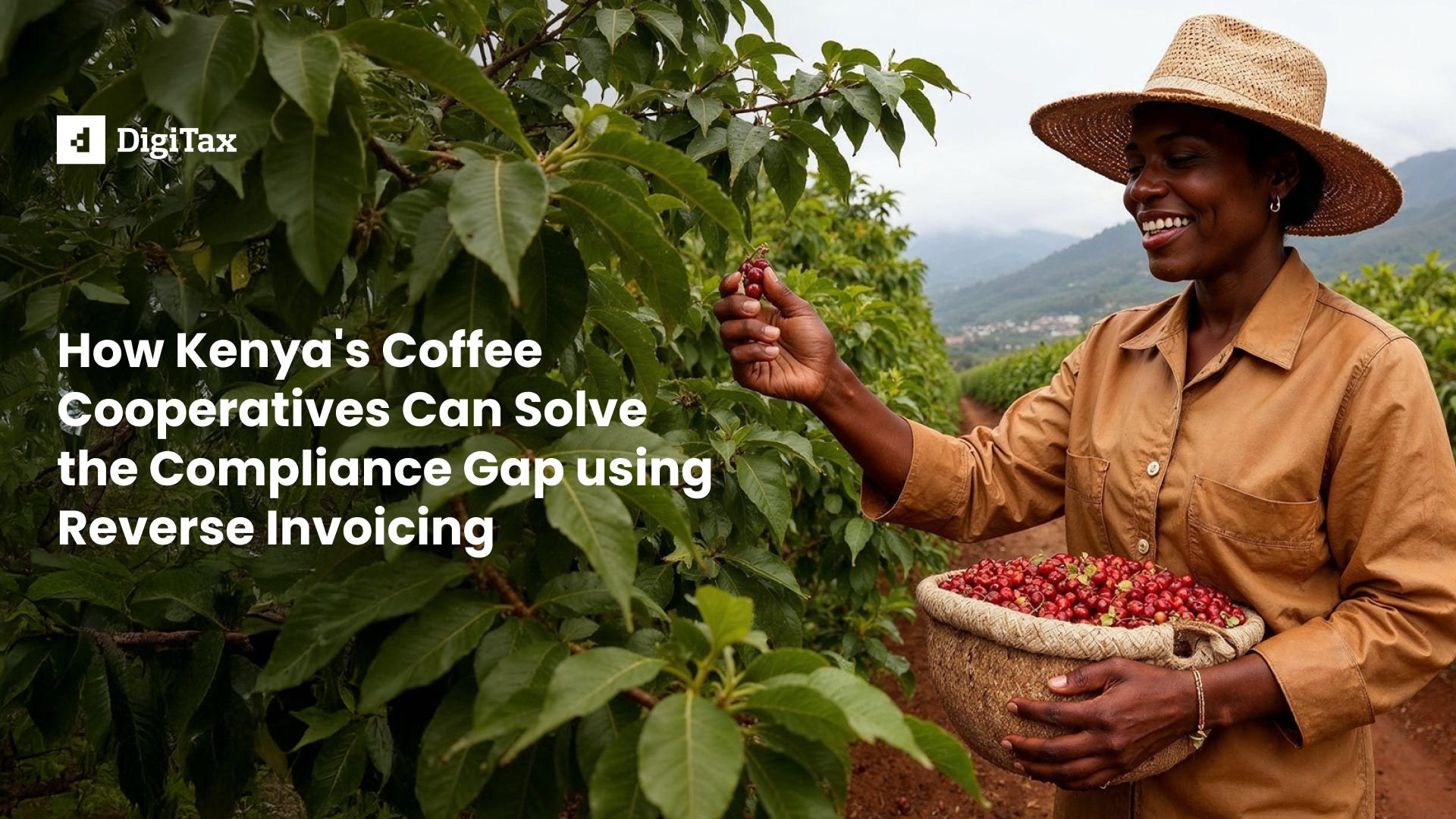
Kenya’s coffee industry isn’t just agriculture — it’s a highly regulated commercial system. When a smallholder farmer in the Central Highlands delivers a bag of coffee cherries to their cooperative’s pulping station, a taxable supply has just occurred.
The farmer won’t issue an eTIMS invoice. The cooperative probably won’t receive one either. And under Kenya’s Tax Laws (Amendment) Act, 2024, that creates a compliance problem that ripples all the way up the value chain from the farm gate to the Nairobi Coffee Exchange.
The Coffee Act, 2026 establishes a framework of licensed participants: growers, cooperative societies, millers, brokers, buyers, warehouse operators, roasters, exporters, and agents. Licences are issued across three bodies the Coffee Board of Kenya, county governments, and the Capital Markets Authority, depending on the activity.
Each of these participants is an independent taxpayer. Each has its own eTIMS documentation obligations. And each transaction between them — including the payment of licence fees to government — needs to be supported by a compliant invoice.
That sounds straightforward until you reach the base of the chain.
Where eTIMS Compliance Breaks Down
Smallholder farmers form the productive core of Kenya’s coffee industry. Most of them are delivering cherries to pulping stations operated by cooperative societies. Under eTIMS rules, that delivery is a taxable supply. The cooperative is purchasing from a supplier.
But smallholder farmers, as a group, do not have the tax literacy, the devices, or the connectivity to generate eTIMS-compliant invoices. And without a compliant invoice, the cooperative cannot support that payment as a deductible expense.
Multiply this across thousands of deliveries per season, and the aggregate compliance exposure is significant.
Central Settlement System
The Coffee Act introduces a Central Settlement System for clearing and settling coffee sales. This is a structural feature designed to protect growers money flows through a single clearing mechanism rather than through ad hoc bilateral arrangements.
But compliance-wise, it creates complexity. Every point at which money moves is also a point at which documentation obligations arise. Brokers, agents, and warehouse operators holding coffee warrants all have roles in this settlement chain — and each needs to be able to match their financial records with eTIMS-compliant documentation.
Reverse Invoicing
The Tax Laws (Amendment) Act, 2024 introduced a direct response to this problem: Reverse Invoicing. The mechanism allows a purchasing entity to generate an eTIMS-compliant invoice on behalf of its supplier, with the supplier’s consent.
For cooperative societies paying smallholder farmers for cherry deliveries, reverse invoicing is operationally logical. Cooperatives already maintain the records — delivery weights, quality grades, payment amounts. What they need is a compliant invoicing mechanism tied to those records. With an approved third-party integrator, that function can be embedded directly into existing payment workflows.
The same logic applies upstream. Brokers and agents earning commissions on direct sales, and millers paying growers for parchment, face similar supplier documentation gaps. Reverse invoicing addresses those too.
What Reverse Invoicing Doesn’t Solve
One point the Coffee Act’s framework makes clear: even when a cooperative or miller takes on the invoicing function for a smallholder, the farmer still has their own deductible expenditure to account for. Farm inputs, transport, and primary processing all represent real costs. A farmer who receives a reverse invoice from their cooperative has solved the cooperative’s problem — but not their own claim on deductions.
Closing that gap requires financial literacy programming delivered through cooperative societies, millers, and government extension services. Not as a separate initiative — as part of the same compliance programme.
Reverse Invoicing Implementation
Practically, eTIMS compliance in the coffee sector requires three things to work in parallel:
First, reverse invoicing capability integrated into cooperative and miller payment systems, supported by a compliant third-party integrator.
Second, broker and agent documentation processes updated to generate or receive compliant invoices for commissions and service fees.
Third, structured eTIMS awareness delivered to smallholders — not as a compliance burden, but as an enabling service so they can capture the deductions they’re entitled to.
The Coffee Act, 2026’s structure creates natural delivery channels for all three. Cooperative societies are already the primary interface between the state and smallholder farmers. The compliance infrastructure can move through the same channels.
Ready to Implement Reverse Invoicing at Scale?
DigiTax provides eTIMS-compliant reverse invoicing solutions for cooperative societies, millers, and agribusiness buyers across Kenya.