

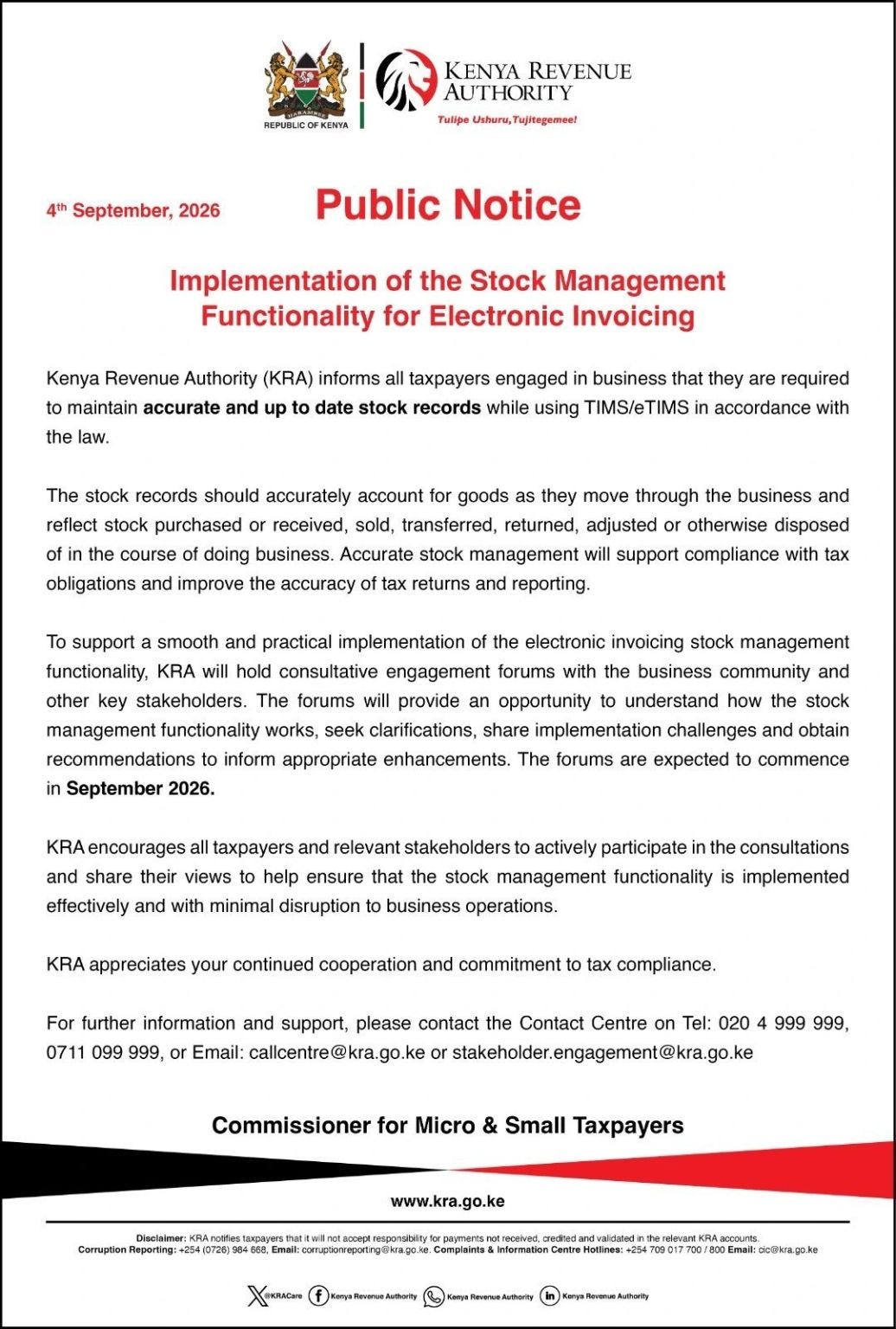
On 4 September 2026, KRA issued a public notice informing taxpayers that a stock management functionality will be rolled out for eTIMS. The notice requires all taxpayers engaged in business to maintain accurate and up-to-date stock records that reconcile with eTIMS. This is a new development being introduced and we detail here below this additional compliance obligation.
Summary of the KRA Public Notice
The notice wishes to inform taxpayers that stock records must accurately account for goods as they move through a business. This includes goods purchased or received, sold, transferred, returned, adjusted or otherwise disposed of in the course of doing business.
KRA also announced that it will hold consultative engagement forums with the business community and other key stakeholders, with the forums expected to commence in September 2026. These forums will allow businesses to understand how the functionality works, seek clarifications, share implementation challenges, and provide recommendations.
What this means in practice
Until now, eTIMS has primarily been concerned with the issuance of invoices and the validation of expenses supporting with eTIMS compliance invoices. According to this new notice, businesses will have an additional obligation to reconcile stock movement with eTIMS.
This will effectively tie stock records to the tax compliance. KRA will be able to see, in real time, what stock a business holds, what has moved, and whether the stock movements align with the invoices and returns on file. Businesses that currently manage stock informally, on spreadsheets or through manual systems that are not connected to eTIMS, will need to reconsider their approach.
Why this matters for audits
Stock discrepancies have in some instances led to tax audits. Unexplained differences between opening stock, purchases, sales and closing stock are among the most common triggers for deeper KRA scrutiny. If eTIMS now tracks stock movements in real time, KRA will have an additional point against which to cross-check returns.
Therefore, the sales and claim cost of goods sold will be required to align to eTIMS and amounts on iTax and any variances explained.