

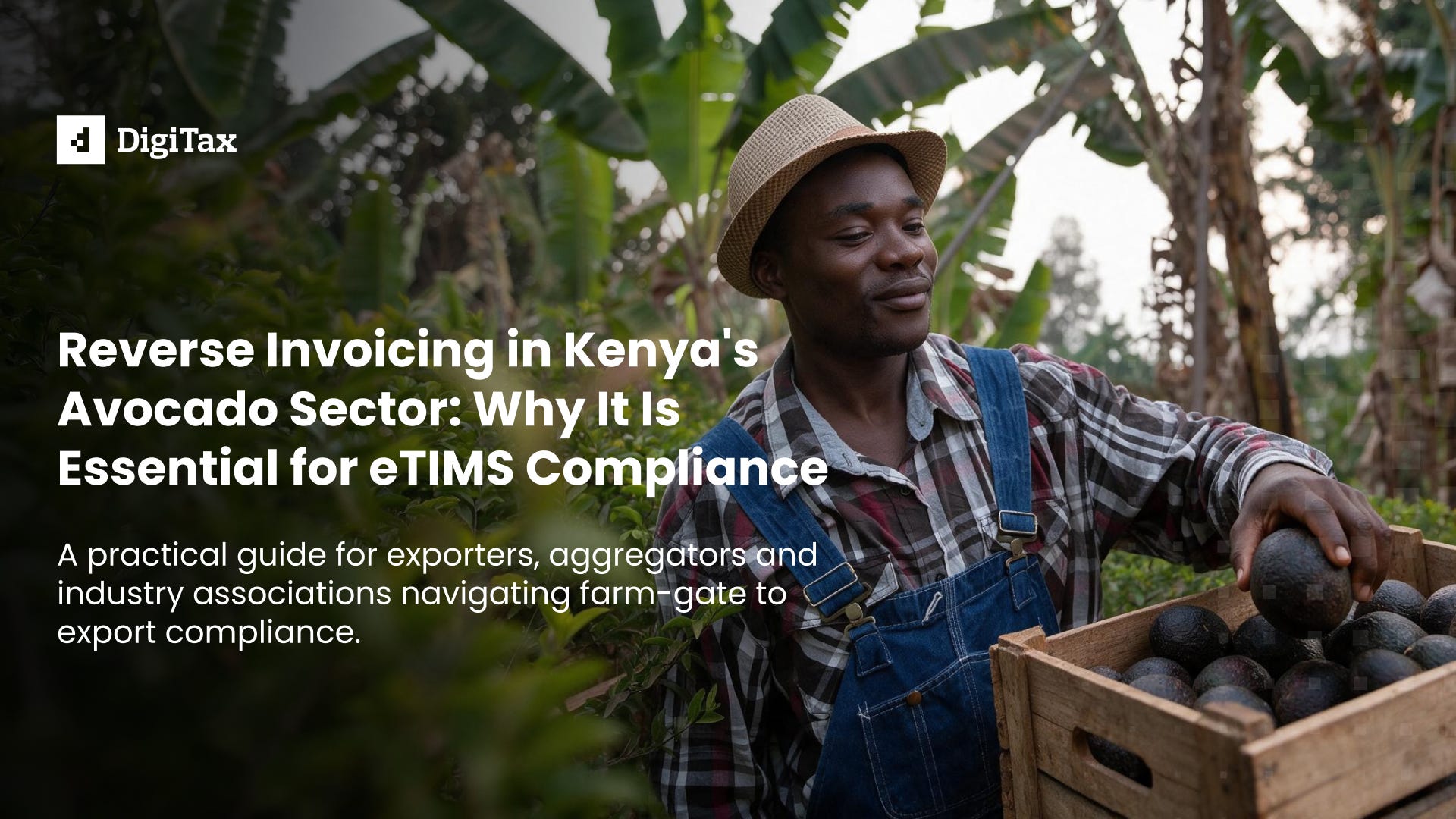
Kenya’s avocado sector has become one of the country’s most visible horticultural success stories. Export volumes have climbed steadily over the past decade, farmers across Murang’a, Kiambu, Nakuru, Kandara and beyond have shifted from subsistence to commercial cultivation, and international buyers increasingly treat Kenyan avocado as a reliable, quality-certified supply source. But behind that growth story sits a tax compliance problem that gets far less attention than it should: most of the value chain that moves an avocado from farm gate to export container is invisible to eTIMS.
That invisibility is not a minor administrative footnote. It is a structural feature of how the sector sources fruit, and it exposes exporters, aggregators and cooperatives to real audit and deduction risk. Understanding why the gap exists and how reverse invoicing closes it matters for anyone operating in or advising this value chain.
Why eTIMS Compliance Is Non-Negotiable Here:
Every business in the avocado value chain is required to issue eTIMS-compliant invoices for taxable supplies and to hold eTIMS-compliant documentation to support tax-deductible expenses. This obligation doesn’t pause at any single point in the chain it applies from the first farm-gate purchase through to the point of export. In principle, that’s a straightforward requirement. In practice, the avocado value chain has a structure that makes it unusually difficult to meet.
Three Structural Challenges Unique to This Sector
Smallholder sourcing at scale - Most exporters and traders don’t buy from a handful of large commercial farms they buy from thousands of individual smallholders, often through local buying agents. Each delivery is its own transaction requiring its own compliant documentation. The reality on the ground is that a large share of these farmers have no KRA PIN, no access to an invoicing system, and little to no awareness that eTIMS obligations even apply to them.
Buying agents and brokers as an inherited gap - Exporters commonly rely on agents who aggregate fruit from multiple farmers across a growing area. These agents’ own purchase records are frequently not eTIMS-compliant, and the individual farmer transactions underneath them are often undocumented entirely. The exporter doesn’t create this gap but they inherit it, along with the compliance exposure that comes with it.
A fragmented logistics layer - Avocados are perishable and depend on unbroken cold chain handling from farm to port. That means exporters are working with refrigerated transporters, casual loaders, fumigation providers and clearing agents a layer of small and informal service providers, many of whom are not issuing eTIMS-compliant invoices for their services.
Put together, these three factors mean the documentation gap in avocado sourcing isn’t an edge case. It’s the default state of the transaction.
How Reverse Invoicing Solves It
Reverse invoicing flips the usual invoicing relationship: instead of waiting for an undocumented supplier to issue a compliant invoice they may never be able to produce, the buyer generates the eTIMS-compliant invoice on the supplier’s behalf, with the supplier’s consent.
For an avocado exporter, this means a compliant invoice can be generated at the moment fruit is delivered, or when payment is processed, without requiring every farmer in the network to operate their own invoicing system.
The mechanism works best when it isn’t a standalone add-on but is built directly into procurement and payment workflows. A third-party integrator such as DigiTax can generate these invoices automatically, drawing on farmer records, buying data and payment information already flowing through the exporter’s systems.
What Sector-Wide Adoption Could Look Like: The AEA Kenya Model
The Avocado Exporters Association of Kenya (AEAK) brings together the country’s licensed avocado exporters — and is well positioned to coordinate reverse invoicing adoption at a sector level rather than leaving each exporter to solve the problem alone.
Coordinated member onboarding - Rather than every exporter separately negotiating integration approaches with KRA and technology providers, an association-led framework could establish a standard integration model, agreed data formats and a template consent process that all members adopt cutting duplicated effort and creating sector-wide consistency.
Farmer consent and registration at scale - Supplier consent is a prerequisite for reverse invoicing, and for an exporter sourcing from 5,000 farmers, collecting that consent individually is a serious administrative undertaking. An association-coordinated approach field teams running registration drives in key growing regions, collecting consent and verifying farmer details makes this tractable.
A shared farmer database - Because exporters frequently source from overlapping farmer populations, a centralised, association-managed database holding each farmer’s name, ID number and PIN, with appropriate data protection safeguards would let members check whether a farmer is already registered and consented, reducing duplication and speeding up procurement across the board.
Reverse invoice generation at the buying point - Once farmer data is centralised, generating the invoice itself becomes almost automatic. When a buying agent logs a delivery from a registered farmer, the system generates a reverse invoice, transmits it to KRA via eTIMS, and links it to the eventual payment. DigiTax, as a third-party integrator, can provide this technology layer configured to work with each member’s own payment and procurement systems while drawing on the shared farmer registry.
Farmer education as a force multiplier - An association-led education programme reaches far more farmers per shilling spent than individual exporter efforts ever could. Training materials explaining eTIMS and reverse invoicing and the very real upside for farmers, including that documented sales strengthen their own tax position and improve access to credit delivered through workshops at collection centres during buying season, reach farmers exactly when compliance is most relevant to them.
The Bottom Line
Voluntary compliance is no longer a sustainable strategy for the avocado sector. The combination of high-volume smallholder sourcing and heavy reliance on informal service providers means the documentation gap will keep widening unless it’s addressed structurally. Reverse invoicing offers exporters, aggregators and cooperatives a practical path to protect their deductions, reduce audit exposure, and build a fully documented value chain without asking thousands of smallholder farmers to become invoicing-system operators overnight.
For exporters and industry associations exploring what eTIMS implementation and reverse invoicing could look like for the avocado sector, DigiTax can help.
Ready to Implement Reverse Invoicing at Scale?
For guidance on eTIMS implementation and reverse invoicing solutions tailored to the Avocado sector. Get in touch to find out how it fits your business.