

On 31 August 2026, the Kenya Revenue Authority confirmed that the integration between eTIMS and IFMIS is now live. That is a short sentence for a change with a very concrete effect: from now on, the invoice a supplier submits for payment isn’t just checked by a procurement officer or an accountant — it’s checked against KRA’s own record of that invoice, automatically, before Treasury lets the money move. If the two don’t agree, the payment doesn’t move either.
eTIMS and IFMIS: Two systems that now talk to each other
Most businesses that deal with government already know eTIMS — the Electronic Tax Invoice Management System, KRA’s platform for generating tax invoices that carry a verifiable digital signature. It’s how KRA sees a sale the moment it happens, rather than at year-end filing.
IFMIS is the other half of the picture, and it lives entirely on the government’s side. The Integrated Financial Management Information System is what every ministry, county government, and state corporation uses to process its own finances — budgets, expenditure, and critically, supplier payments. Until now, IFMIS took a supplier’s invoice largely at face value; whether it actually matched what KRA had on file was someone else’s problem, discovered later, if at all.
The integration closes that gap. IFMIS can now query eTIMS directly and validate an invoice before payment is authorised. KRA frames this as part of the government’s Digital Transformation Agenda — more transparency in public spending, tighter compliance, less manual reconciliation. For a supplier, the framing matters less than the mechanism: your invoice is now cross-checked at the point of payment, not the point of filing.
Step 1: Supplier generates an invoice in eTIMS for the supply
Step 2: That invoice is recorded on KRA’s own eTIMS ledger
Step 3: Same invoice details submitted to the government entity for payment via IFMIS
Step 4: IFMIS validates the match against eTIMS — payment releases only if they agree
What the notice actually says
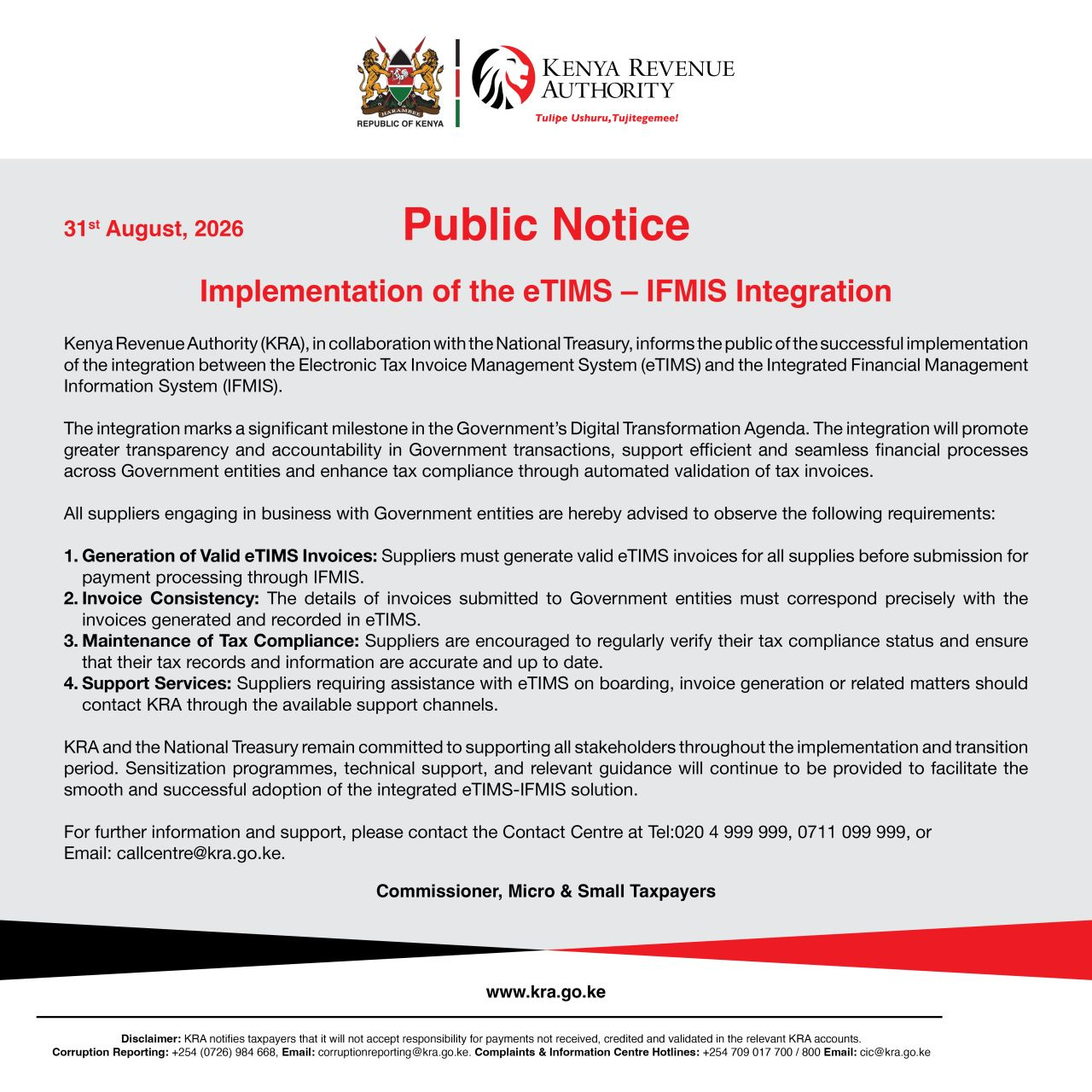
KRA’s public notice sets out four requirements for any business supplying a government entity. Worth reading in the original before unpacking what each one means day to day.
KRA Public Notice — Implementation of the eTIMS – IFMIS Integration
Generate the eTIMS invoice first, not after
The invoice submitted for government payment has to already exist in eTIMS before it goes anywhere near IFMIS. There’s no sequence where you invoice the client on your own letterhead, get a purchase order moving, and generate the eTIMS copy afterward to tidy up the books.
In practice: Whatever issues your invoices — a billing clerk, an accounting package, a spreadsheet — eTIMS generation has to be the first step in the sequence, not the last.
Invoice consistency is now machine-checked
“Correspond precisely” means exactly that — the amount, the KRA PIN, the item descriptions, the date, the invoice number. A figure rounded differently on the payment voucher than on the eTIMS invoice, or a line item re-typed by hand into a different format, is now a discrepancy a system flags, not a nuance a clerk waves through.
In practice: Any manual re-typing of an eTIMS invoice into a separate payment claim, LPO, or voucher is now a point of failure. The two documents need to be the same record, not two versions of it.
Compliance status can hold up an otherwise valid invoice
A correctly generated, correctly matched invoice doesn’t fully insulate a supplier if their broader tax standing has lapsed — outstanding returns, arrears, an expired compliance certificate. KRA is explicit that suppliers should keep verifying their status, not just their invoices.
In practice: Treat your Tax Compliance Certificate the way you treat your business licence: something to renew ahead of time, not something to discover has lapsed when a payment stalls.
Support exists — but only if you use it before, not after
KRA points suppliers who need help onboarding to eTIMS or generating invoices toward its support channels. That’s a genuine offer, and also a signal: KRA expects unfamiliarity with the system to be resolved proactively, not discovered at the payment desk.
In practice: Budget time to train whoever issues your government invoices on eTIMS specifically — a delay caused by not knowing the system reads the same as a delay caused by noncompliance.
The real risk is cash flow, not paperwork
Why this matters more than it sounds
Government contracts already run on long payment cycles — 30, 60, sometimes 90-plus days is normal even when everything is in order. Under the old process, a mismatch between what a supplier billed and what KRA had on record was something an accountant might catch and quietly fix weeks later. Under the integrated process, IFMIS can hold the payment at the gate the moment it doesn’t reconcile — before it enters the approval queue at all.
For a business that leans on government work for a meaningful share of its revenue, that isn’t a compliance footnote. It’s a working-capital problem: payroll, supplier terms, and rent don’t wait for a resubmitted invoice to clear a second validation cycle. The businesses most exposed are exactly the ones the notice is addressed to — the micro and small suppliers for whom one delayed government payment can ripple through the rest of the business.
Where DigiTax Fits
The mismatch this notice warns against almost always starts the same way: an invoice gets generated once for eTIMS, and generated again — by hand — for whatever the government entity’s payment process asks for. Two versions of the same sale, produced separately, are two chances to disagree.
DigiTax removes the second version. It generates your eTIMS invoices directly from your actual sales data and keeps them synced with KRA in real time, so there is exactly one invoice record — the one KRA already has. Whatever you submit through IFMIS is, by construction, identical to what’s already sitting in eTIMS, because it’s the same invoice, not a re-entered copy of it.
That’s the whole fix: no gap for a rounding error, a re-typed PIN, or a stale invoice number to slip into, and no manual step between generating the invoice and submitting it for payment.
Talk to us to get started on +254 112 685368 or +254 795 279403/ Email us at support@namiri.tech or Request a Demo