

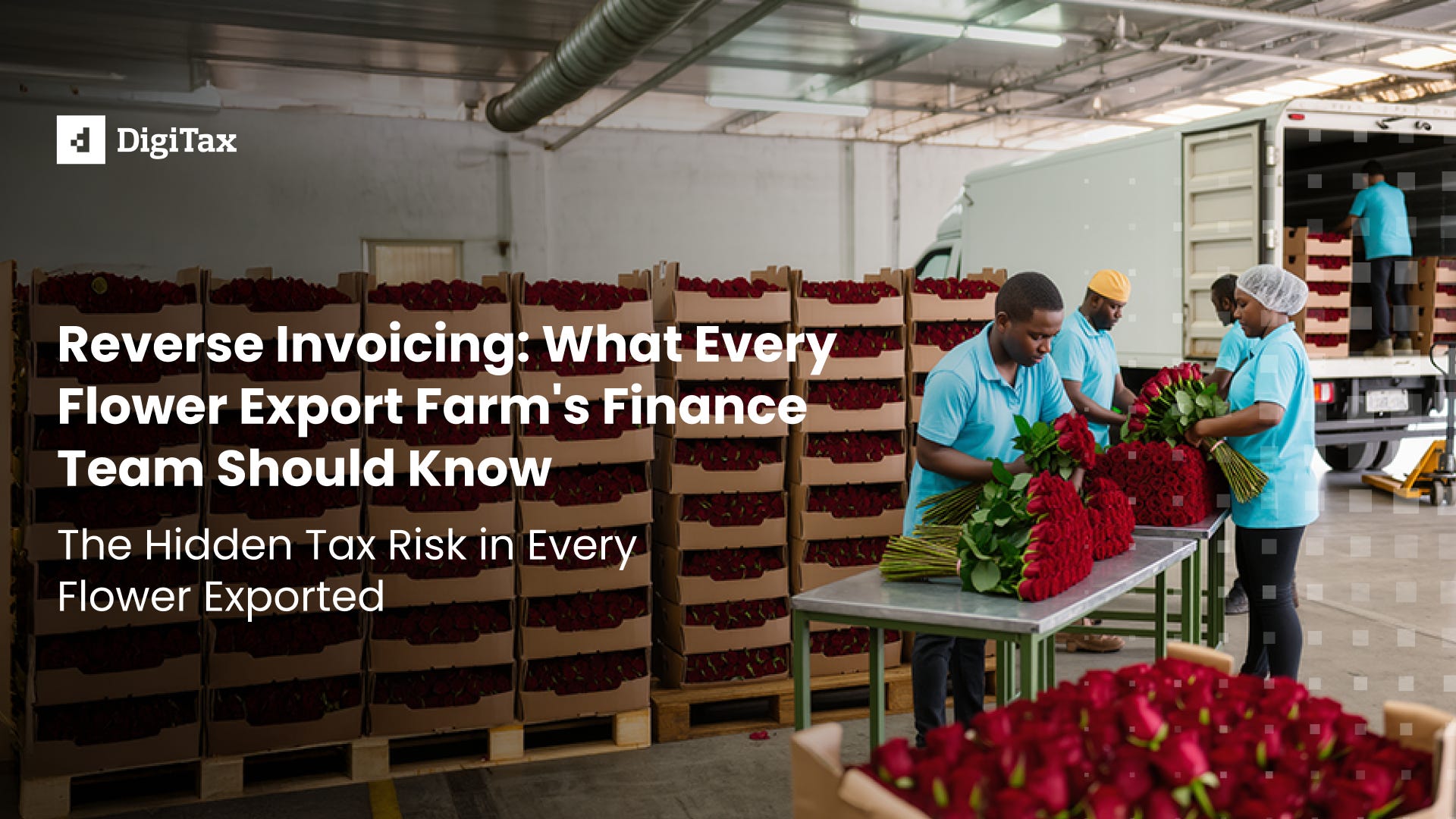
There’s a version of Kenya’s flower industry that everyone sees: greenhouses stretching along the shores of Lake Naivasha, refrigerated trucks racing to catch the night flight out of JKIA, stems that were cut in Kericho appearing in a Dutch auction house or a UK supermarket bucket less than 48 hours later.
Then there’s the version almost no one talks about — the hundreds of small, informal transactions that keep that whole system running. The carton supplier in Naivasha town. The mechanic who keeps the irrigation pumps alive. The casual labour team brought in for grading and bunching during peak season. The transporter with two refrigerated trucks and no VAT number.
Most of these businesses will never register for VAT. Most will never touch the KRA portal. And under the letter of the law, that used to mean the flower farms buying from them were carrying real tax exposure — not because the farm did anything wrong, but because its suppliers were operating below the radar of Kenya’s digital tax infrastructure.
That’s the problem reverse invoicing was built to solve.
Since the Finance Act, 2023, every business expense in Kenya is expected to be backed by an eTIMS-compliant invoice, effective 1 January 2024. Fine in theory — until you consider that a huge share of Kenya’s economy is made up of small suppliers who simply don’t have the infrastructure, or the turnover, to justify getting eTIMS-registered.
The Tax Laws (Amendment) Act, 2024 closed that gap with a mechanism called reverse invoicing. In plain terms: if you’re a compliant, resident buyer purchasing a non-exempt supply from a resident supplier whose annual turnover is under KES 5 million, you don’t wait for that supplier to become compliant. You issue the eTIMS invoice yourself, on their behalf.
All four conditions have to be true at once. And when they are, this isn’t optional — the law requires the buyer to do it.
Why This Hits Floriculture Sector Most
Flower farms sit at an unusual intersection. They’re large, formal, export-oriented businesses — and yet their entire cost base is built on relationships with small, informal, often rural suppliers: agro-input dealers, packaging providers, cold-chain operators, casual labour, farm maintenance crews.
Almost none of them clear the KES 5 million threshold. Almost none of them are VAT-registered. Which means, without reverse invoicing, a flower farm is sitting on two quiet but expensive problems:
Expense disallowance. If a cost can’t be backed by a valid invoice, it doesn’t count for corporate income tax purposes — so real operating costs end up inflating taxable profit.
Lost input VAT. No valid invoice, no VAT claim. That’s cash the farm can’t recover, transaction after transaction.
Multiply either of those across a few hundred weekly supplier payments, and the number stops being a rounding error.
Reverse Invoicing in Action
Here’s the part that trips farms up: reverse invoicing is a mandatory obligation, but it was never designed to be executed manually. A farm processing hundreds of supplier payments a week cannot realistically have someone keying each qualifying transaction into the KRA portal one at a time. It doesn’t scale, and it doesn’t stay accurate.
That’s where integration comes in. DigiTax, a KRA-accredited eTIMS integrator, connects directly into a farm’s existing ERP system so that reverse invoicing happens automatically, as part of the procurement workflow that’s already running — not as a separate compliance task bolted on afterward.
What This Looks Like in Practice
Picture a mid-sized rose farm on the shores of Lake Naivasha — sixty hectares under greenhouse, supplementing its own production with stems from over 200 smallholder out-growers, and buying everything from cartons to diesel to casual labour from small local suppliers.
With an integrated reverse-invoicing system in place, the process runs quietly in the background:
A purchase order or goods-received note is captured in the ERP.
The system checks whether the supplier meets the reverse-invoicing criteria — resident, under the KES 5 million threshold, non-exempt supply.
If they qualify, the system generates the eTIMS invoice and submits it to KRA automatically.
The supplier gets a USSD prompt or SMS asking for consent.
Once confirmed, the invoice is stored and reconciled against the farm’s iTax ledger.
The payoff
Beyond simply staying on the right side of the law, farms that automate reverse invoicing end up with something more valuable: a clean, verifiable, time-stamped record of every qualifying transaction, reconciled against their own iTax ledger in near real time. That’s an audit trail that holds up under scrutiny, expense deductions that aren’t at risk of being clawed back, and VAT that actually gets recovered instead of quietly disappearing.
For a sector where margins are already squeezed by freight costs, currency movements, and auction-house pricing, that’s not a small thing.
Ready to Implement Reverse Invoicing at Scale?
DigiTax is a KRA-accredited eTIMS integrator supporting compliance for businesses across Kenya, Zambia, Nigeria, and the UAE. If you’re curious how reverse invoicing could plug into your farm’s existing ERP setup, we’re happy to walk through it.