

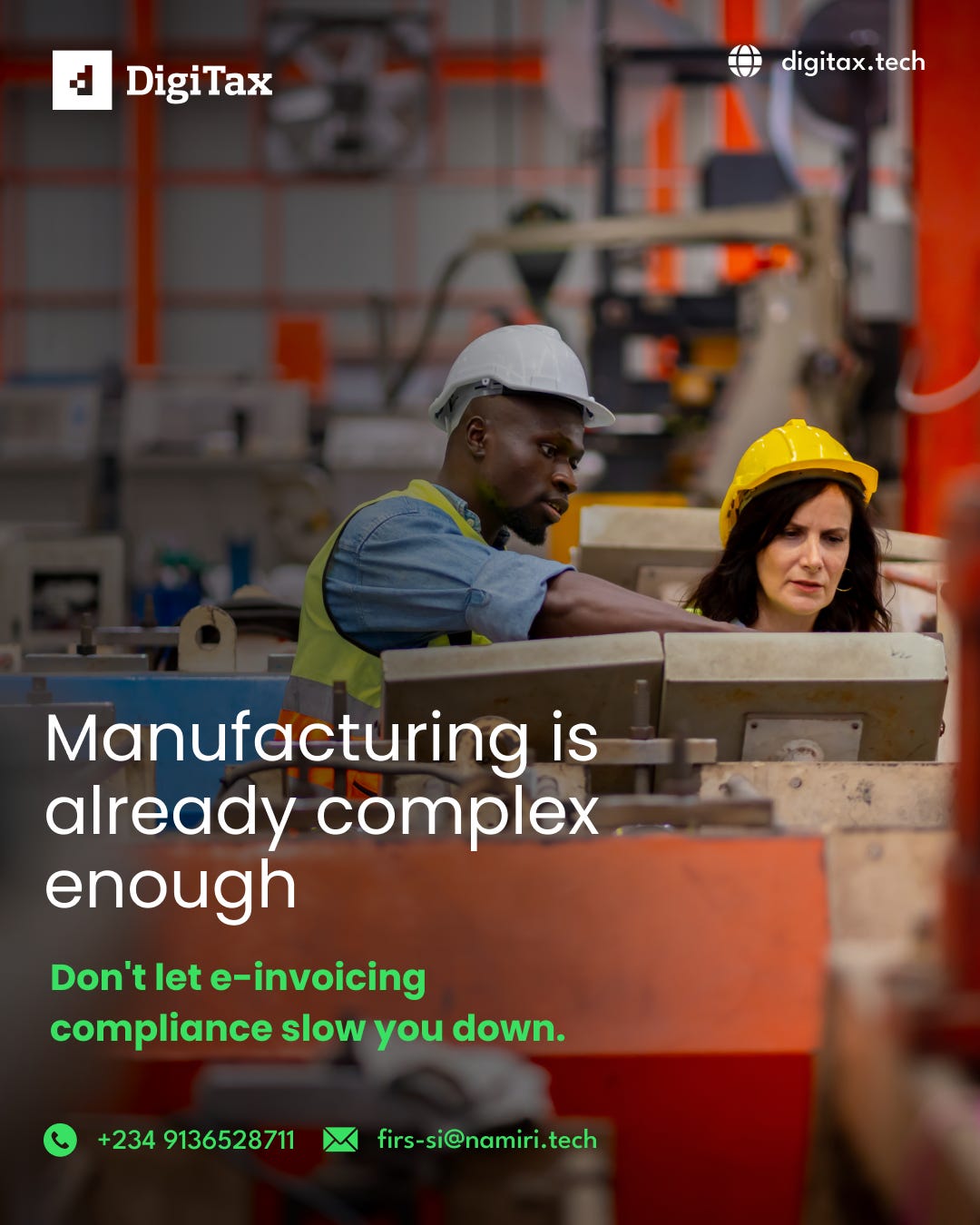
Manufacturing in Nigeria is operationally dense by nature. You are managing raw material procurement, supplier relationships, production scheduling, distribution logistics, and customer invoicing, often across multiple locations and product lines simultaneously. The financial systems running underneath all of that carry enormous weight.
The Manufacturing Context
The NRS framework requires businesses within scope to issue all invoices through certified systems connected to the national infrastructure. Every invoice receives a Unique Invoice Identifier, is validated at the point of creation, and transmitted to NRS in real time. For a manufacturing business operating at scale, the likelihood of falling within scope is high, and the implementation challenge is more layered than it would be for a professional services firm or a retail operation.
Here is why manufacturing is a particular case.
Transaction volumes are high. Depending on scale, your business may be processing hundreds of invoices across suppliers, distributors, retailers, and direct customers. Each one now needs to pass through a certified system and carry a valid UII before it qualifies as a compliant invoice under the framework.
The supply chain runs in both directions. Most manufacturers sit in the middle of a chain, buying from raw material suppliers on one side, selling to distributors or retailers on the other. As e-invoicing adoption expands, the invoices arriving into your business from suppliers will also need to carry UIIs. Your accounts payable function needs to be set up to handle and verify incoming compliant invoices, not just issue compliant ones on the outgoing side.
Existing systems are frequently fragmented. Many manufacturing businesses operate with a combination of ERP platforms, standalone accounting tools, and manual processes for certain parts of the operation. E-invoicing compliance requires that your invoicing process, wherever it happens across your business, is connected to the NRS infrastructure. That kind of integration across a complex operational environment takes deliberate planning and adequate time.
Cash flow is tightly linked to invoice timing. In manufacturing, when invoices are issued matters. Payment delays ripple back into procurement and production schedules. A well-implemented e-invoicing system brings measurable visibility and predictability to your invoice-to-payment cycle, but that outcome requires a structured implementation, not a last-minute one.
What the NRS Has Said About the Business Benefits
The Nigeria Revenue Service has been direct about the operational value built into the e-invoicing framework, not just as a tax administration tool, but as a genuine business benefit for companies that implement it properly.
E-invoicing reduces the cost of compliance: When invoicing is automated and connected to the national framework, the administrative overhead of manual reconciliation, paper record management, and month-end documentation falls significantly. For a manufacturing business with high transaction volumes, the cumulative cost saving is material.
It lessens the tax audit burden: A business operating within the NRS framework has a complete, timestamped, traceable record of its invoicing history. When FIRS conducts an audit, that record is structured and accessible. The contrast with a manufacturing business trying to reconstruct documentation from disconnected systems is stark, and the risk profile is fundamentally different.
It improves cash flow: Because invoice status is visible and traceable from creation to payment, the unpredictability that characterises many manufacturing payment cycles begins to reduce. Disputes are resolved faster. Payment timelines become more consistent. For CFOs managing complex procurement and distribution cash cycles, this is a meaningful operational shift.
It reduces fraud risk: The authenticity and integrity requirements embedded in the e-invoicing framework make invoice fraud, whether from internal sources or external suppliers, significantly harder to execute. For a manufacturing business with high volumes of supplier invoices, this is not a minor benefit.
It increases productivity: Automating invoice processing removes a category of repetitive administrative work from your finance team. That capacity gets redirected. In a manufacturing environment where finance teams are often stretched across complex multi-site operations, the productivity gain compounds.
Why This Is a Board-Level Decision
E-invoicing compliance in a manufacturing business touch the entire organisation.
Which systems need to be integrated? How does the NRS connection interact with your ERP or production management software? Who is responsible for ensuring that incoming supplier invoices are compliant? How does your distribution arm handle invoicing for trade customers? These are operational and technology questions as much as they are finance questions, and they require leadership to define scope, allocate resources, and set timelines.
Practical Starting Points for Manufacturers
Confirm your compliance position: Work with your finance and tax advisory team to establish whether your business is within scope and what the timeline means for your specific situation.
Map your invoicing landscape: Before integration can begin, you need a clear picture of where invoices are generated across your business, procurement, sales, distribution, and any subsidiary operations. Complexity that is not mapped upfront becomes a problem during implementation.
Engage a certified integration partner early. E-invoicing compliance requires connection to the NRS through a licensed System Integrator or Access Point Provider. This is not something your existing accounting software vendor can push through automatically. It requires certified expertise and a formal integration process. DigiTax Nigeria is licensed under the NRS mandate and works directly with finance teams to manage the full integration process, from ERP connectivity to live transaction validation, so your business meets compliance requirements without disrupting operations.
Build a timeline that fits your operational reality. Manufacturing businesses have production schedules, procurement cycles, and seasonal demand patterns. Your implementation timeline needs to account for these, including testing periods and staff onboarding, without cutting across critical operational windows.
The Bigger Picture
For manufacturers, the businesses best positioned in that environment will be the ones that treated implementation as a strategic operational decision. The infrastructure you build now, how your invoicing connects to your ERP, how your finance team works with real-time invoice data, how your supply chain manages compliant documentation, is infrastructure that will serve the business long after the compliance deadline has passed.
Send an email on firs-si@namiri.tech or call +234 913 652 8711 to book a Demo.